
How do you approach a film that is drastically different from its source material? I dealt with that question in 2017 when Sony released The Dark Tower, a film based on Stephen King’s epic multi-volume series and one that had a profound effect on my life. As I read about the hurdles the movie faced on its way to the big screen, I was well-aware that The Dark Tower was going to veer significantly from King’s novels, so that when I finally watched the film, I managed to enjoy it for what it was, rather than for what I’d wanted it to be. I’m among the minority, mind you, and The Dark Tower was immediately reviled upon release for its brevity (100 minutes to so) and its significant straying from its origins.
As a teenager, Bret Easton Ellis’s 1985 novel Less Than Zero also had a profound effect on me. While my life in Toronto, Ontario, was drastically different from the characters in the book, whose own existences were fueled by sex and drugs and rock and roll and ennui, the way that Ellis told their stories was intoxicating and appealed to my own ambitions. Ellis’s economic use of language inspired my own writing; there was nothing flowery about his prose, and he moved briskly from scene to scene, never lingering longer than necessary. In my books and online writing, though mainly non-fiction, I’ve tried to do the same.
The film adaptation of Less Than Zero does adhere to that aspect of Bret Easton Ellis’ work, but not much else. As adapted by Harley Peyton and directed by Marek Kanievska, this version is not nearly as nihilistic as the book, which, for me, was initially difficult to accept in my rewatch.
The original concept of the novel is intact. Clay (Andrew McCarthy) returns home to Los Angeles from college on the East Coast for Christmas break. He reunites with his ex-girlfriend, Blair (Jami Gertz), and his friend Julian (Robert Downey Jr.). In Ellis’ book, Clay is bisexual and a drug user, like every other person he interacts with, including Blair and Julian. The film makes a significant change there, with McCarthy’s Clay being straitlaced and disgusted by the indulgences he sees from his friends. For someone unfamiliar with the novel, this decision works fine; the audience is given someone to relate to. However, for fans of Bret Easton Ellis’ novel, this character bears little resemblance to the one we met and significantly changes the trajectory of the story.
At the behest of the film’s producers and studio, Harley Peyton’s script gives the audience a clearer and cleaner beginning, middle, and a tragic yet positive end:
- Beginning – three friends graduate high school and go their separate ways for a time, reuniting months later to see how they’ve changed.
- Middle – one friend is in trouble, and the other two work to help him.
- End – said friend dies, and the remaining two react and decide to live their lives differently.
Again, this is significantly different from Bret Easton Ellis’ novel, which in many ways is scene after scene after scene of Clay’s experiences on his return home. There’s no moral center, there’s no teaching experience, and there’s no finality in the way that the film delivers. What works in a novel like this couldn’t have necessarily carried over into a film, so as a fan, you have to choose if you can accept these changes or not.
Interestingly enough for me, once I realized the Clay on screen was drastically different from the one in the book, I found myself enjoying Andrew McCarthy’s work. We’re seeing his friends and Los Angeles through his eyes, and the fresh-faced actor delivers with a smirk a character who is removed from his surroundings. Clay looks around at the drugs and debauchery as though he’s above it all, and maybe he is. At least, the drugs, anyway. Watching Clay move through parties, stealing a kiss from one random girl, pinching the ass of another, feels like the character from Ellis’ novel. Clay longs to be with Blair again, going so far as to forgive her and Julian for sleeping together while he’s been away at school. McCarthy’s ultimate shrug of the shoulders at their betrayal is another hint of the Clay from the book; that Clay was busy snorting and fucking anyone, including men, another aspect of the character exorcised for the film.
In looking at various reviews from the past, much was made of Robert Downey Jr.’s performance as Julien, drug-addled and forced to whore himself out to pay back drug dealer Rip (James Spader). There’s definitely no arguing that Downey is dynamic in every scene he’s in; the problem for me in watching 1987 RDJ in 2023 is that it’s hard not see the actor “being” Robert Downey Jr. That has nothing to do with his own issues from the past; it’s that, some 35 years after the release of Less Than Zero, RDJ is a megastar who is always on. It takes a very special role at this point to not feel like I’m watching RDJ play a character; his work in Oppenheimer as Lewis Strauss is a great example of the actor plying his craft and stepping outside of himself. Downey’s performance as Julian is good, if not excellent, but try to find a difference between his approach to Julian and, say, his approach to Bill Busch in Robert Altman’s 1993 film Short Cuts. They feel very much one and the same to me, which is likely why I was less enamoured with Downey in Less Than Zero today than viewers were back in 1987.
For me, the other shining performance in the film, alongside Andrew McCarthy’s, is James Spader as Rip, who feels as though he’s actually ripped from the pages of Bret Easton Ellis’ novel. Young and handsome and deceptively evil, Spader’s Rip is the catalyst of the film, the big bad if you will. Though he makes nice with Clay like some long-lost friend, he’s also Julian’s seductive enabler, keeping him high while on a leash that he refuses to loosen. The scene between Rip and Julian outside on the latter’s balcony, the nighttime glow of the city behind them, is a definite highlight. Spader negotiates the character extremely well, and Less Than Zero is at its best when he’s on screen.
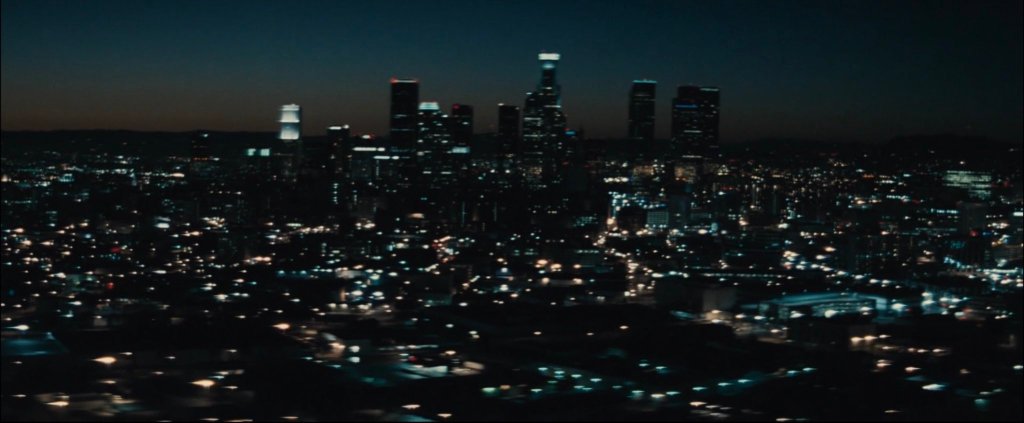
Less Than Zero highlights its Los Angeles environs throughout the film, often in contrasting ways. At the beginning of the movie, set to the sounds of The Bangles’ outstanding cover of Simon and Garfunkel’s “Hazy Shade of Winter,” Clay sits in the back of a cab as he returns home. It’s daylight, and the drive takes us past trendy and expensive shops, palm trees and sunshine, until arriving at Clay’s mother’s own McMansion. There’s nothing dangerous here, just affluence.
The nightlife, the clubs, though, are lit up by neon glows, hard reds, and, as depicted early in the film, images screened on the multiple television sets found at a house party. One of the most memorable moments in the film comes when Clay and Blair stop in the middle of the road to kiss, and Clay’s red 1961 Chevrolet Corvette is passed on either side by a motorcycle gang, the lights of their rides beaming off the car and the camera. Set aside the impossible idea that there’s a street in Los Angeles that a car could stop in the middle of without being honked at, and the moment is quite beautiful.

It’s worth noting that a more accurate depiction of Ellis’ Los Angeles arrived in 1999 in the form of This is Not an Exit: The Fictional World of Bret Easton Ellis, a British documentary on the author that includes actors recreating scenes from his various novels, complete with sex, drugs and more. This movie opens with a straight depiction of Less Than Zero’s beginning and captures the aspirations and overall vibe of Ellis’ novel in a way that film never allows itself to. This is the fault of neither screenwriter Harley Peyton nor director Marek Kanievska, though; by all accounts, it was the various producers who were looking for a far easier to digest film than what Ellis’ work lent itself to. What was lost with that decision, though, was what made the novel so popular in the first place.
Much like the original 1985 novel, Less Than Zero is a film that captures a time and place and world, that being Los Angeles in the mid-1980s and the teens that lived there. The book’s worldview is dimmer, though, its characters directionless and content to drift through their lives with drinks and drugs in hand, stopping only for a sniff or a suck. The film is a different animal entirely, with a moral compass in Clay and a cautionary tale in Julian that can’t help but scream “Just Say No!” As an adaptation of its source material, Less Than Zero only hits its mark on occasion, but taken on its own, it offers a worthwhile snapshot of the era and the city.
 City of Night
Leave a comment